

Street Photography in Rome: Flash and Scams Near the Colosseum
A couple of weeks ago, while shooting street photography during a sunny morning in Rome, I stumbled into a dense, energetic crowd just a few hundred metres from the Colosseum.
What initially drew me into the scene wasn't the crowd itself, but a phrase printed across the back of a man’s t-shirt near the centre. I stepped in close, raised the camera, and fired off a frame with off-camera flash.
The moment the flash popped, the energy of the crowd flipped instantly.
A chorus of "No picture! No picture!" went up from several men standing around the circle. It was only in that split second, watching their immediate, aggressive reaction, that I realized what I had actually walked into: the classic street scam known as the "Three Cards Game" (gioco delle tre carte).
The Setup: Spotting Street Scams in Rome
If you’ve ever walked around in major European cities, you know the setup. It’s never just one guy with a cardboard box and three cups. It’s a coordinated operation of 9 or 10 people: one dealer, three or four fake players pretending to win quick cash to draw in tourists, and half a dozen lookouts stationed on the perimeter.
Immediately, one of the lookouts broke off from the group and marched straight towards me. He stepped directly into my personal space, telling me to leave and gesturing aggressively for me to move along.
I have an almost non-existent tolerance for this kind of hypocrisy. Here I was, an Italian citizen standing in a public space in my own country doing nothing illegal, being physically intimidated and ordered around by someone running an active, fraudulent scheme in broad daylight. As you might imagine, my reaction was to, not only hold my ground, but also take a few more frames just to cause commotion and provoke them. Probably not the best course of actions but I really despise people with this kind of behaviour.
Escalation and the Friction of Public Space
As one of the scammer got closer, pushing me back, I asked him in Italian if he spoke the language."No," he replied. I asked him in English if he spoke English."No," he said again, naming his home country—a place I won't disclose here as it’s irrelevant—while continuing to insist that I get lost.
Now, as luck would have it, some of my closest friends back home are from that exact same country. Over the years, they’ve taught me a choice selection of their native language’s “most colorful and slightly offensive vocabulary”—the kind of words that are always the very first thing you pick up when you spend enough time around native speakers.
I finally had a practical occasion to test them out: I looked him in the eye and delivered a couple of those choice phrases.
Safe to say, my audience wasn't thrilled. The tone changed from stern posturing to genuine anger, and the pushing got significantly firmer.
This particular guy wasn't personally much of a physical threat to me, but I wasn't about to start a 10-on-1 brawl right next to the Colosseum over a photo. Knowing when to escalate and when to disengage is part of working close in the street.
I backed off towards some police officers standing roughly 200 metres down the road and reported the situation, pointing directly at the group running the scam.
Their response? The usual: absolute indifference. They didn't even bother to walk over.
For those curious about statistics: I called or asked the police for help in Italy five times now in the span of my life. Four of these five times they either didn’t arrive or didn’t act. The one time they did something, is because I got held overnight for a few hours reporting a stolen wallet. Yes, you read that right.
Final Thoughts for Street Photographers in Rome
Street photography often puts you face-to-face with the underlying friction of urban life: the unwritten rules of the pavement, the illusion of authority, and the apathy of the institutions meant to monitor it. You step into a scene expecting a simple visual note—a phrase on a shirt—and walk away with a vivid reminder of how quickly the street can test your boundaries.
Key Insight
Flash acts as a diagnostic tool in crowded urban environments. When you light up a scene, anyone operating in the shadows or running illegal activities will self-identify immediately. Know your surroundings, maintain your composure, and know when to take the frame and walk away.
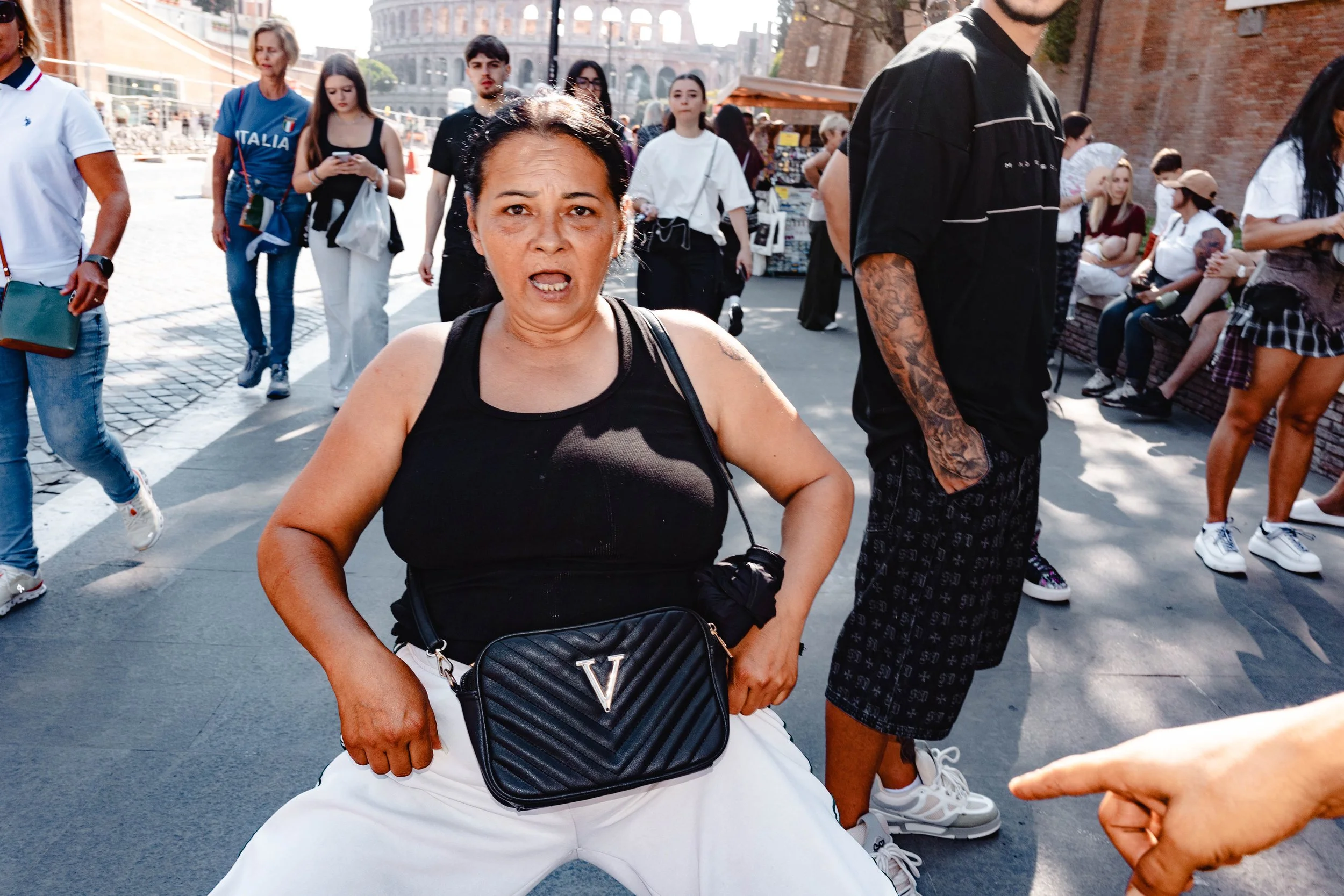
One of the scammers provoking me with “photograph this”, which clearly I did, and to “eat it” but in Rome you can find much better things to eat.
