

Lost in Neon: Travelling & Street Photography in Osaka
A Complete Travel & Street Photography Guide for First-Time Visitors
This guide is designed to give you everything you need: the practical essentials for navigating Japan for the first time, a deep dive into every neighbourhood and attraction that makes Osaka worth your time, and a dedicated chapter on street photography.
Whether you have three days or three weeks, by the time you finish reading this, you will be ready.
Table of Contents
- Before You Go: Japan Essentials
- Getting Around Japan: Trains, IC Cards & the JR Pass
- Getting to Know Osaka
- Food: Eating Your Way Through Osaka
- Where to Stay
- Common Day Trips from Osaka
- Street Photography in Osaka
- Galleries & Museums for Photography Lovers
- Frequently Asked Questions: Osaka Travel & Photography
Before You Go: Japan Essentials
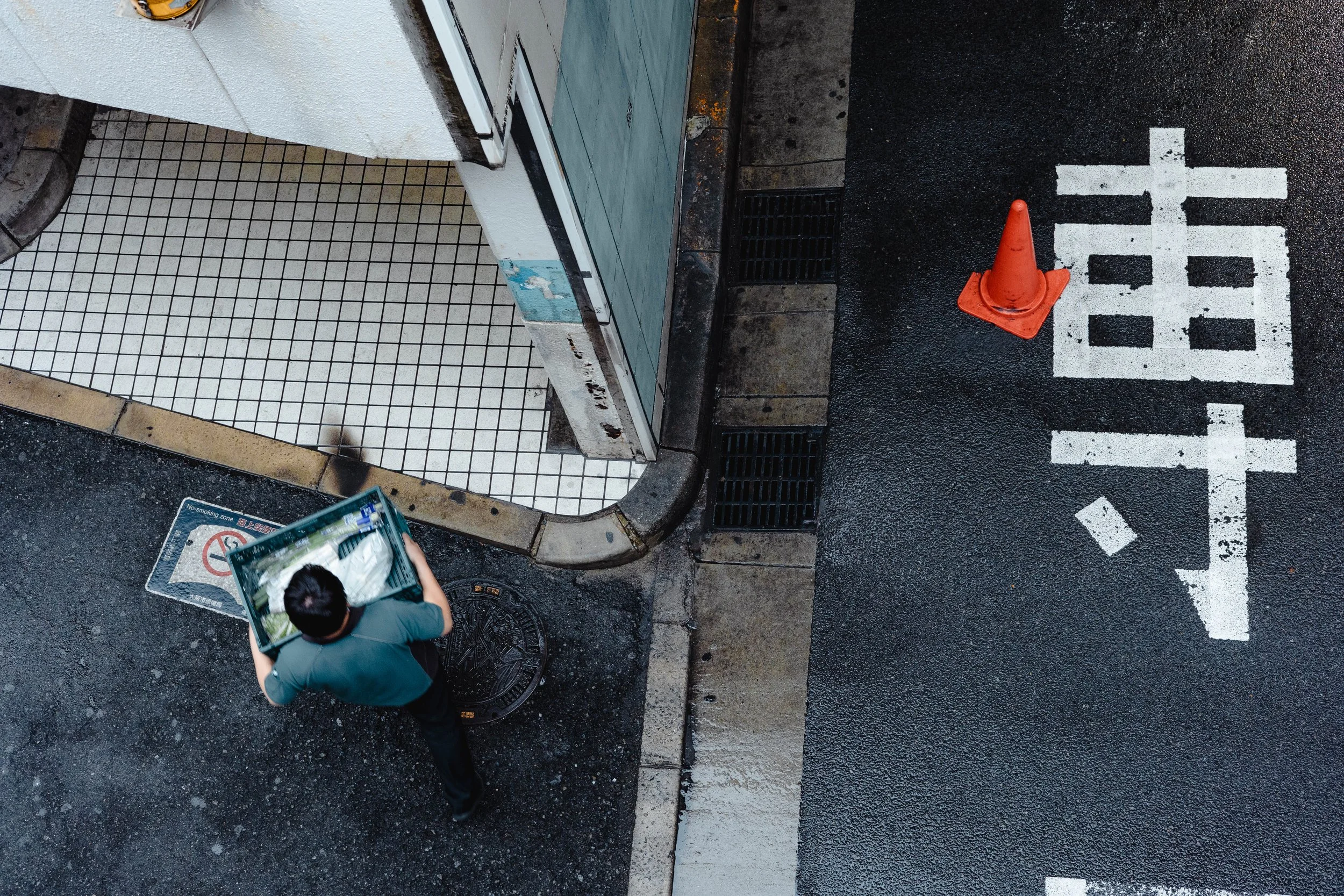
Early morning preparations in Osaka Umeda
Some of the things you’ll read here are the same I wrote in the Tokyo blog post in the last section “Tips for Enjoying Tokyo and Japan“. This time I’ll start with these as someone made me aware that some of these things are best known right from the start.
Understanding Osaka and Japan as a First-Timer
Japan can be a bit intimidating: there is a huge language barrier and the etiquette is.. intricate. But people are generally kind, or at least they strive to appear kind, the food is good and transports are efficient. Like everywhere else, the key is to go with openness and a little preparation — which is exactly what this section is for.
When to Visit Osaka
Spring (late March – early May): This is Japan's peak travel season, and for good reason. Cherry blossom season (sakura) transforms Osaka Castle Park and the riverbanks into clouds of soft pink. Temperatures are mild and perfect for walking. Book accommodation well in advance — this is the busiest and most expensive time of year.
Autumn (October – November): The second most popular season, when the city turns copper and gold with autumn foliage (koyo). Crowds are smaller than spring, prices are slightly lower, and the weather is still pretty warm.
Summer (June – August): Hot, humid, and intense. June and July are rainy season (tsuyu). That said, summer is alive with energy — rooftop bars, yukata-clad locals, and the spectacular Tenjin Matsuri festival in July, one of Japan's top three. If you can handle the heat (and don’t underestimate how hot and humid it gets), this is Osaka at its most vibrant.
Winter (December – February): Crisp and quiet. Osaka sees few tourists in winter, which means shorter queues, lower prices, and a more local feel.
Visas & Entry
Citizens of most Western countries — including the US, UK, EU nations, Canada, Australia, and many others — can visit Japan visa-free for up to 90 days. On arrival, you will fill in a short immigration card and go through passport control. Japan has a Visit Japan Web portal where you can pre-register your immigration and customs forms digitally, which speeds up the process considerably. It is worth registering before you fly.
Money: It’s All About Cash
Japan has a unique relationship with cash. While contactless payments and credit cards are increasingly accepted in cities, many restaurants, temples, shrines, and smaller shops still operate on a cash-only basis. Arriving with yen — or withdrawing it from a 7-Eleven ATM (one of the most reliable for foreign cards) — is essential.
The coin pro tip: You are going to end up with a mountain of coins. If you pay cash in any convenience store insert all the coins you have and any change that you’ll get will be in the form of the bigger sized coins available.
Tipping: Do not tip. Tipping is not part of Japanese culture and can even be considered rude. Excellent service is simply the standard — no extra payment expected or wanted.
Getting a SIM Card & Staying Connected
Staying connected in Japan is easy and affordable. Your options are a pocket WiFi device (rented at the airport), a tourist eSIM (convenient if your phone supports it — buy before you travel), or a prepaid data SIM. Rakuten, IIJmio, and various airport vendors offer reliable prepaid SIMs. Most deliver unlimited data for around ¥3,000–¥5,000 for a two-week trip.
The best one I tried so far is Mobal which is both cheap and has a fast-enough network.
Remember to download Google Translate’s Japanese dictionary in advance just in case. Also Google Translate's camera feature, which translates text in real time through your camera, is genuinely life-changing in Japan.
Safety
Japan is among the safest countries in the world for travellers. Petty crime is extremely rare. Walking alone late at night is generally comfortable in Japanese cities. The main hazards are natural: earthquake preparedness is built into Japanese life, and following local guidance in the unlikely event of a significant quake is important.
Language
Among 123 non-English speaking countries and regions, Japan is ranked 96th in English proficency. Therefore I recommend learning a handful of phrases — 'sumimasen' (excuse me), 'arigatou gozaimasu' (thank you), 'eigo wo hanashimasu ka?' (do you speak English?) and getting familiar with the Google Translate interface.
Basic Japanese Etiquette
Japan famously has a large set of unwritten social rules:
On the train - Stay quiet. Phone calls are frowned upon. Many Japanese people will not speak above a whisper. Avoid eating on local trains (shinkansen are fine). Give up priority seats to elderly, pregnant, or disabled passengers.
Shoes - Be prepared to remove your shoes when entering a traditional accommodation, many temples, and some restaurants. Look for a step up at the entrance (genkan) as your cue.
Bowing - A small bow when greeting or thanking someone goes a long way. You do not need to perfect the angle — the gesture itself is what matters.
Queuing - The Japanese queue for everything, and in the right order. Stand on the left (usually but not always) on escalators (in Osaka — note this is the reverse of Tokyo) and queue at the marked spots on train platforms.
Rubbish bins - Famously scarce in Japan. Almost non existent. You must carry your trash with you but you can find bins in almost any convenience store and bottles-only bins next to most vending machines.
Tattoos - Some onsen (hot spring baths) and sento (public bathhouses) still prohibit visible tattoos, a legacy of their association with organised crime. It is worth checking in advance if you plan to visit one but usually everyone is fine if you can cover them up.
Getting Around Japan: Trains, IC Cards & the JR Pass
Japan's train system is punctual, clean, well-signed, and almost incomprehensibly extensive. Understanding it takes a little time, but the investment is well worth it.
IC Cards: Your Secret Weapon
An IC card is a rechargeable contactless card that works on almost every train, subway, and bus across Japan. Think of it like an Oyster card in London or a Navigo in Paris, but better — it also works in convenience stores, vending machines, and many restaurants. For Osaka and the Kansai region, pick up an ICOCA card (issued by JR West) at Kansai International Airport or any major station. The name is a play on the Kansai dialect phrase 'Iko ka,' meaning 'Shall we go?' — which perfectly captures its spirit.
Top it up with cash at any ticket machine and tap in and out at every gate. All IC cards (ICOCA, Suica, Pasmo, etc.) are fully interchangeable across Japan since 2013, so whichever one you pick up is fine.
If you have an Iphone you can just add a card to the wallet, just select “Transportation card” and then search for Suica or Pasmo (maybe even ICOCA although I’m not sure about this one).
The JR Pass
The Japan Rail Pass gives unlimited travel on most JR lines nationwide for 7, 14, or 21 days. Whether it is worth buying depends entirely on your itinerary. If you plan to take multiple shinkansen (bullet train) journeys it can represent excellent value (for reference a one way Shinkansen from Tokyo to Osaka costs about 15000 yen). If you are mostly staying in the Kansai region, a Kansai regional pass will likely be cheaper.
Be aware that the JR Pass does not cover the fastest Nozomi and Mizuho shinkansen services — use the slightly slower Hikari or Sakura trains instead (which are less frequent). It also does not cover local subway lines, so keep your IC card topped up regardless.
Getting from Kansai Airport to Osaka
Kansai International Airport (KIX) sits on an artificial island in Osaka Bay. From here, you have different options.
The Haruka express train runs directly to Osaka Station (Umeda) and Shin-Osaka in around 50–75 minutes — fast, comfortable, and easy with luggage. If you have a JR Pass, this train is covered.
Tthe Nankai Electric Railway connects the airport to Namba in around 45 minutes, which is useful if your hotel is in the south of the city. Or you can simply change lines in Namba.
Another option is the express bus service which will drop you off near Umeda Links (Umeda station).
Getting Around Osaka
The Osaka Metro is efficient, decently-signed in English, and covers the city's main attractions comprehensively. The Midosuji Line (red line) is the most useful for visitors, running north-south through Umeda, Shinsaibashi, Namba, and Tennoji. The JR Osaka Loop Line circles the city and is useful for the castle and the bay area. Your ICOCA card covers all of these seamlessly.
Many of Osaka's main attractions are genuinely walkable from one another — Dotonbori, Namba, Shinsaibashi, Hozenji Yokocho, and Kuromon Market can all be done on foot. Cycling is also popular; several rental services operate around the city, and Osaka's flat terrain makes it ideal for bike exploration.
Getting to Know Osaka
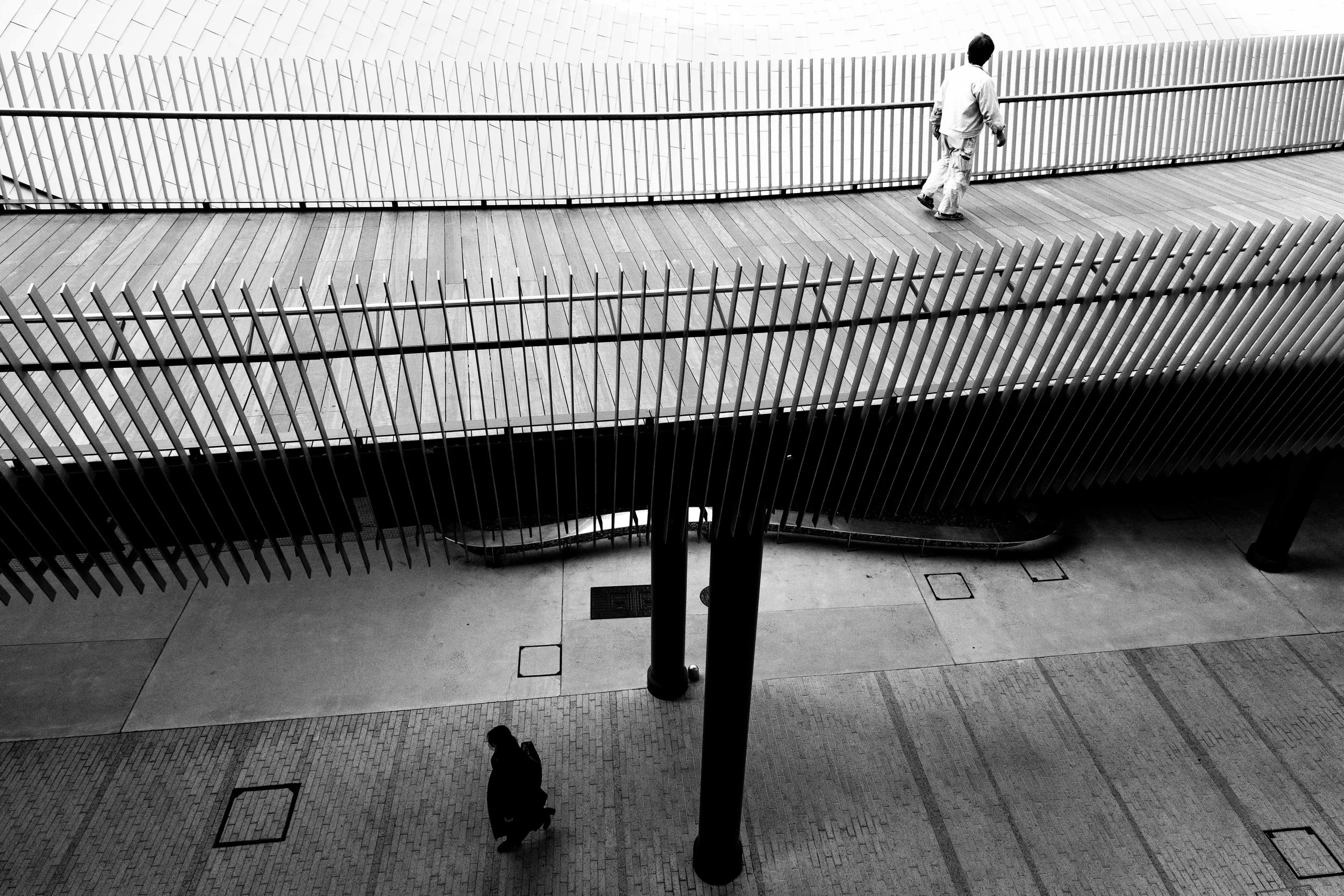
Umeda Grand Green but in black and white.
The Neighbourhoods: Your Osaka Map
Osaka is a sprawling city, but its most interesting areas are clustered in two main zones: Kita (north) and Minami (south), connected by the Midosuji subway line — the city's main artery.
Namba & Dotonbori
This is the heartbeat of tourist Osaka, and for good reason. The Dotonbori canal area is one of the most overwhelming places in Japan: towering neon signs, mechanical crabs rotating above restaurant facades, the giant Glico Running Man billboard glowing above the water. It is simultaneously kitsch and magnificent. The surrounding streets are packed with kushikatsu (deep-fried skewers) restaurants, takoyaki stands, and izakayas (Japanese pubs). At night, reflected in the canal, the whole area blazes with colour. Come here on your first evening and prepare to be overwhelmed.
Shinsaibashi & Amerika Mura
Just north of Namba, Shinsaibashi is Osaka's main shopping district — a long covered arcade (shotengai) crammed with fashion, cosmetics, and everything in between. Tucked inside it is Amerika Mura ('America Village'), a quirky enclave of vintage clothing stores, street art, and independent boutiques beloved by Osaka's youth.
The contrast between polished retail and counter-culture grit is very Osaka.
Umeda & Nakanoshima (Kita)
Cross north on the Midosuji line and you arrive in Umeda, Osaka's business and upscale shopping district. The Umeda Sky Building is here, with its spectacular Floating Garden Observatory that offers panoramic views of the city. Nakanoshima, a narrow island between two rivers just south of Umeda, is Osaka's cultural heart — home to the National Museum of Art, the Nakanoshima Museum of Art, city hall, and beautiful riverside walks. Considerably more serene than the south, it rewards a slower afternoon (but nights can be equally lively in Umeda).
Nakazakicho
One of Osaka's hidden gems and a favourite of those who take the time to find it. Just a few minutes from Umeda by subway, Nakazakicho is a bohemian neighbourhood of narrow streets, old wooden houses converted into cafés, vintage clothing stores, independent bookshops, and small art galleries. It has the feel of a pocket Tokyo neighbourhood transplanted into the Osaka grid. If you find the main tourist areas exhausting, come here for an afternoon coffee and a breath of calm.
Shinsekai & Tennoji
Head south from Namba and you reach Shinsekai, which translates literally as 'New World' — though it has not felt particularly new since the 1950s, which is precisely its charm. This retro, slightly scruffy district grew up around the Tsutenkaku Tower and has the feel of an old Tokyo working-class neighbourhood. Kushikatsu restaurants and pachinko parlours line the streets. It is one of the most atmospheric and photogenic areas in the city. Just south of Shinsekai, Tennoji holds one of Osaka's best parks, a really tall observation deck at the Harukas 300 and the superb Osaka City Museum of Fine Arts.
Osaka Bay Area
On the western waterfront, Osaka Bay is home to Universal Studios Japan — a full-day theme park experience that is genuinely world-class, particularly for fans of Nintendo. Also here is the Osaka Aquarium Kaiyukan, one of the largest and most impressive aquariums in the world. Worth the trip if you have families, children, or simply love marine life.
Top Attractions
Osaka Castle (Osaka-jo)
The castle was originally built in 1583 by Toyotomi Hideyoshi and has been rebuilt and restored several times over the centuries. Today's version, reconstructed in 1931 and renovated in 1997, is an eight-storey concrete reconstruction with a museum inside tracing the castle's remarkable history. While purists note it is not an original structure, the gold-tipped black and white exterior rising above the moat and stone walls is magnificent — particularly during sakura season when the surrounding park is carpeted in blossom.
Take the lift to the top floor for views across the city (ticket needed, you can get it there but I recommend getting it on GetYourGuide as it costs the same, it’s in English and, because it’s an affiliate link, you help me as well).
Dotonbori Canal Walk
More than just a photo stop, Dotonbori rewards an evening of slow wandering. Start at Ebisubashi Bridge (the Glico sign bridge) and explore outward from there: down the riverside promenade, through Hozenji Yokocho (a tiny stone-paved alley with a moss-covered Buddha statue and traditional lanterns), and deep into the back streets where the best izakayas hide. The river cruise, departing from nearby piers, offers a lovely and crowd-free perspective on the neon skyline.
Kuromon Ichiba Market
Known as 'Osaka's Kitchen,' this 600-metre covered market is a feast of sensory overload. Around 170 stalls sell fresh seafood, fruits, pickles, wagyu beef, and prepared foods — many stalls will grill or prepare items for you to eat right there. It gets busy by mid-morning on weekends; arrive early on a weekday for a calmer experience and fresher produce.
Tsutenkaku Tower & Shinsekai
The Tsutenkaku Tower has been Osaka's retro landmark since 1956 (the second version, rebuilt after the original was demolished during WWII). At 103 metres, it is no longer the city's tallest structure, but its observation deck offers a charming low-altitude view and the surrounding Shinsekai district is well worth several hours of exploration. At the tower's top floor sits Billiken, the 'God of Good Fortune' — legend says rubbing his feet brings luck. The photo of you doing so is essentially obligatory.
Map | Website | Tickets (on GetYourGuide)
Umeda Sky Building
Two skyscrapers connected at the top by a circular sky garden and an open-air observation deck — the Floating Garden Observatory. The views from the rooftop are spectacular, particularly at sunset when the city turns golden below you. Getting here requires a slightly theatrical escalator ride through the upper floors that is part of the appeal. The underground floor of the building recreates a 1920s Showa-era market quarter that is surprisingly charming.
Map | Website | Tickets (on GetYourGuide)
Sumiyoshi Taisha Shrine
One of Japan's most ancient shrines, Sumiyoshi Taisha predates Buddhism's arrival in Japan. The distinctive architectural style — sloping roofs, no Chinese influence, simple wooden structures — is serene and beautiful. A striking arched vermilion bridge leads to the main shrine complex. It is less visited than many Osaka attractions, which makes it all the more special.
Map
Wrestling
Osaka’s wrestling scene—known locally as Puroresu—offers a feast for the soul. The city is widely regarded as the most passionate wrestling market in Japan, characterized by a crowd that is famously "louder" and more vocal than the typically reserved audiences in Tokyo. This "Naniwa" (old Osaka) energy creates an electric atmosphere where fans don't just watch; they participate, engaging in a dialogue of roars and rhythmic chanting that turns every match into a communal event.
What makes the Osaka scene truly distinct is its blend of world-class athleticism and unapologetic comedy. The city’s namesake promotion, Osaka Pro Wrestling, is the perfect embodiment of this, featuring colorful, masked characters inspired by local icons like the "Ebisu" god or the city’s famous food culture.
Sumo
Sumo in Osaka is synonymous with the Haru Basho (Spring Tournament), a 15-day spectacle held every March that transforms the city into the national epicenter of Japan’s most ancient sport. The tournament takes place at Edion Arena Osaka, right in the heart of the Namba district.
As you walk through Namba during the tournament weeks, it’s common to see massive, yukata-clad wrestlers navigating the narrow neon streets, blurring the line between a centuries-old Shinto ritual and modern urban life.
Attending a match is as much about the ritual as it is the wrestling. Each day follows a strict crescendo, starting with junior matches in the morning and peaking with the elite Makuuchi division in the late afternoon. The air inside the arena becomes thick with the scent of hair wax (bintsuke) and the rhythmic sound of the referee’s chants. You’ll witness the dohyo-iri (ring-entering ceremony), where wrestlers stomp their feet to drive away evil spirits, and the explosive tachi-ai (initial charge), where hundreds of pounds of muscle collide with a sound like a literal car crash. Whether you are sitting in a traditional floor-cushion "box" seat or a standard chair, the experience is a sensory overload of salt-throwing, silk-clad referees, and high-stakes drama.
Website | Official Tickets | Third party service for tickets | Tickets on GetYourGuide
Shitennoji Temple Flea Market
The Shitennoji Temple Flea Market in Osaka is a renowned monthly event held on the 21st and 22nd of every month. Located in the Tennoji area, it is considered one of the largest and oldest temple markets in the Kansai region.
Hundreds of stalls sell old ceramics, vintage kimonos, obi fabrics, Japanese swords, and furniture but you can also easily find retro toys, collectibles, and everyday miscellaneous items. There are also a few street food stalls offering takoyaki, okonomiyaki, and traditional snacks.
Note that most vendors do not accept credit cards therefore cash is essential. Also the market is held outdoors. During summer it gets very hot as there is not much shade around and, in general, it may be cancelled in extreme weather.
Location: Shitennoji Temple, 1-11-18 Shitennoji, Tennoji-ku, Osaka.
Hours: Approximately 8:30 AM to 4:00 PM (or sunset).
Admission: Free.
Best Time to Visit: Early morning (around 7:00 AM - 8:00 AM) to beat crowds and secure the best items.
Best Day: The 21st typically features more vendors and a larger variety of goods than the 22nd.
Access: A 5-minute walk from Shitennoji-mae Yuhigaoka Station (Tanimachi Line) or about 10-15 minutes from JR Tennoji Station.
You can find more information and images on this website: Shitennoji Flea Market in Osaka: A Monthly Event for Bargain Hunters - Osaka.com.
Shops and Other Experiences
Over the years I put together a list of favorite shops and things to do in Osaka that I recommend cheking out, especially if you’re looking for novelty or souvernirs: check it out here (Google Maps link).
A few recommendations out of that (and others) list:
Variety store -> レトロベースフクシマ
Arcade games -> Elemeka Laboratory - Electro-Mechanical Arcade Games
Longest arcade in Japan -> Tenjinbashi-suji Shopping Street
Bar with a Basketball Playground -> Basketball Bar Penetrate
Videogame Bar -> PC and Retro Bar Space Station
Food: Eating Your Way Through Osaka
Osaka is Japan's undisputed culinary capital. 'Kuidaore' — eat until you drop — is not a slogan but a philosophy. The city has developed its own distinct cuisine, and eating here is genuinely one of the greatest pleasures Japan offers.
Takoyaki: The Osaka dish above all others. Ball-shaped batter filled with diced octopus, pickled ginger, and green onion, cooked in special dimpled iron pans and served with a glossy takoyaki sauce, bonito flakes, and mayonnaise. Try them at Aizuya in Namba (said to be the original) or just at any street stall.
Okonomiyaki: A savoury pancake mixed with cabbage, egg, pork belly or seafood, and cooked on a griddle at your table. Slathered in okonomi sauce and mayonnaise, topped with bonito flakes that dance in the heat. A full meal.
Kushikatsu: Meat, seafood, and vegetables on skewers, battered and deep-fried. Served with a communal dipping sauce — and the golden rule is never double-dip. Shinsekai is the classic place to eat kushikatsu; Daruma is the most famous chain.
Izakaya culture: The izakaya — Japan's version of a pub that serves food — is central to Osaka life. Order small plates (yakitori, karaage, edamame, sashimi) and keep them coming. The Tenma neighbourhood north of the castle is lined with tiny izakayas spilling into the street and is one of the best places in the city to eat and drink like a local.
Convenience stores:in Japan they are genuinely excellent. 7-Eleven, Lawson, and FamilyMart sell fresh onigiri (rice balls), hot drinks, noodles, sandwiches, and sweets that are noticeably better than anything you would expect from a convenience store elsewhere in the world.
My favorite eating spots
I can’t write an article about a city without sharing my favorite eating spots:
Among those I really recommend trying:
Korean Food -> Korean food Love chicken by Danmi Shinsaibashi
Bakery -> naoto.pan
Izakaya -> 炉端と釜めし 五百蔵
Maze soba -> soba MAREN Nakazakityo
Brunch \ Pancakes -> A Happy Pancake Shinsaibashi
Comprehensive Google Maps lists here: food | drinks | bakeries | pizza
Bonus Section: Donuts
This is the product of one of my many side-quests and, as it turns out, Osaka has a surprisingly great donut scene! Here are the spots worth knowing about:
Kitahama Donuts (near Yodoyabashi) is probably the most talked-about independent shop in the city and it’s my personal favourite. It's closed on weekends and they stop selling donuts around lunch time.
Naoto.pan so far the best bakery I found in Osaka.
どーなつてるの? (which, according to Google, translates to “What’s going on?“
Hanauta Donuts is a charming corner shop near Utsubo Park. They specialise in old-fashioned non-yeast donuts — crumbly and denser. The neighbourhood around Utsubo Park is lovely for a wander too.
Hara Donuts (Tenjinbashi) is a local favourite with a loyal following. Their specialty is little dough pieces made from soy milk and soy grounds, freshly made when you order, coated in powdered sugar and slightly chewy with a hint of butter caramel. Multiple locations around the city.
B portland Coffee Bakery in Amerika Mura (Shinsaibashi) is very popular right now.
A1 Bakery easy to miss as it is tucked away in an arcade full of little food shops.
All donuts places in yet another Google Maps list here.
Where to Stay
Osaka's accommodation ranges from world-class luxury to characterful budget guesthouses. For first-time visitors, the most important factor is location — specifically, proximity to the Midosuji subway line.
Namba / Shinsaibashi: The most central and lively area for visitors. Everything is walkable, the atmosphere is buzzing until late, and every major attraction is within easy reach. Slightly louder than elsewhere.
Umeda / Osaka Station: Better for those who want a slightly calmer base, easy access to the shinkansen (at Shin-Osaka, one stop north), and excellent shopping. More business-oriented, but still very accessible.
Common Day Trips from Osaka
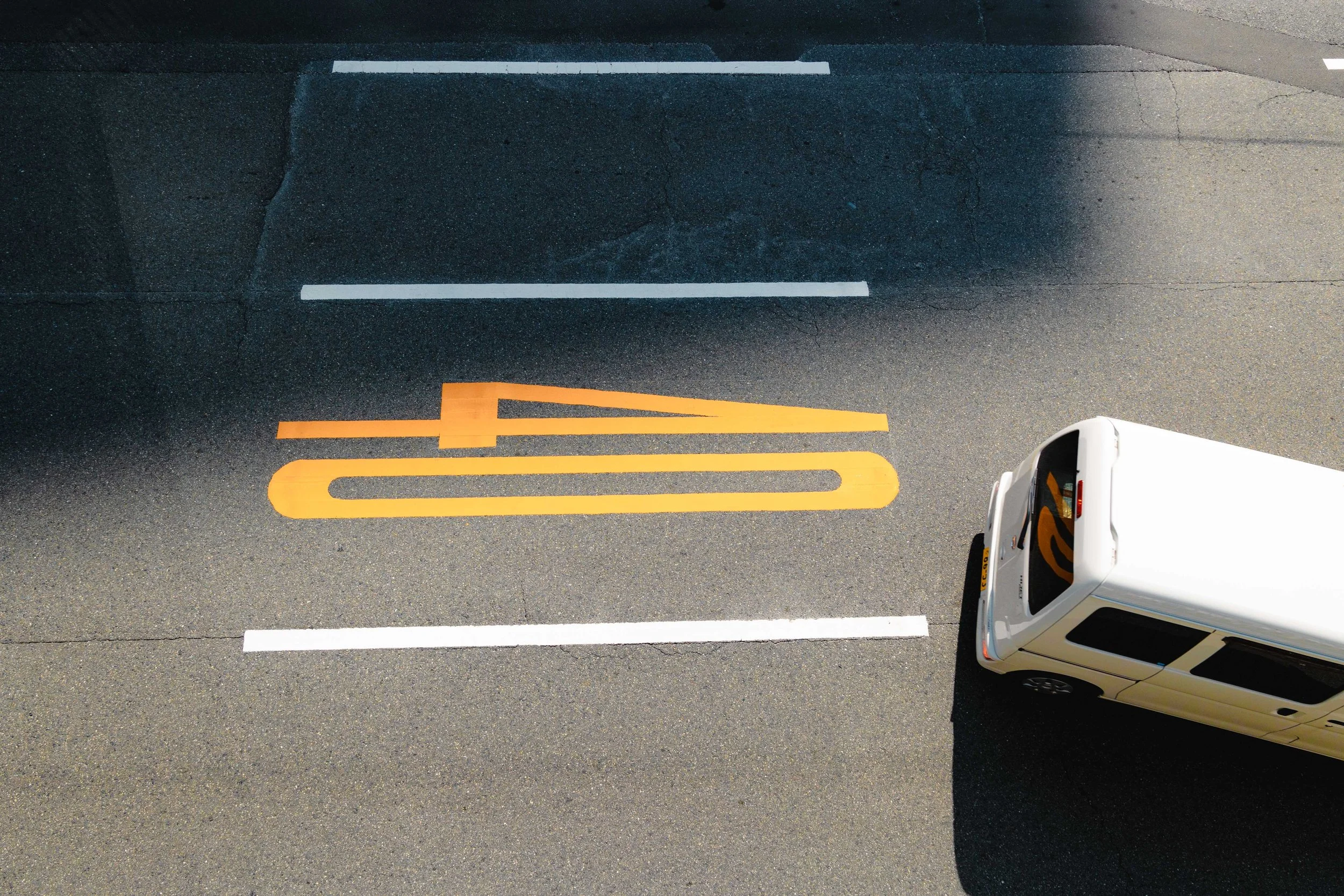
Speed limits in Japan are pretty low compared to Europe.
One of Osaka's greatest advantages as a base is its proximity to some of Japan's most remarkable destinations. All of the following are comfortably reachable as day trips.
Kyoto (30–45 minutes by train)
Japan's ancient capital and cultural heart, Kyoto is home to hundreds of temples and shrines, traditional machiya townhouses, geisha districts (gion), and some of the finest traditional cuisine in the country. Fushimi Inari (the thousands of vermilion torii gates climbing the mountain), Arashiyama bamboo grove, Kinkaku-ji (the Golden Pavilion), and the Philosopher's Path are all essential. Take the JR Shinkaisoku (rapid) from Osaka Station for the fastest and cheapest connection.
Nara (45 minutes from Namba or Osaka)
Japan's first permanent capital is now famous for the hundreds of free-roaming sika deer that wander its ancient park — officially considered messengers of the gods, and utterly unafraid of humans. Todai-ji temple houses the world's largest bronze Buddha inside Japan's largest wooden building, which is itself remarkable. Nara is quieter and gentler than Kyoto, and the combination of deer, temples, and rolling parkland makes it irresistible.
Kobe (30 minutes by train)
Osaka's stylish western neighbour sits against a mountain backdrop above a beautiful bay. Kobe was the first Japanese port to open to Western trade in the 19th century, and the international flavour persists in Kitano-cho, a hillside neighbourhood of Victorian-era Western residences. Kobe beef (wagyu of extraordinary marbling and tenderness) is, of course, the culinary reason to visit. The Nada sake district, where many of Japan's finest sake breweries operate, is also here.
This being said you can find Kobe Beef almost everywhere now and Kobe doesn’t really offer enough in my opinion to warrant a trip. “I’ve been there so you don’t have to”.
Hiroshima & Miyajima (90 minutes by shinkansen)
Hiroshima is one of the most moving destinations in Japan — the Peace Memorial Park and Museum, built around the preserved ruins of the Atomic Bomb Dome, constitute a profound and necessary experience. An hour's ferry ride away, the island of Miyajima holds the iconic Itsukushima Shrine, its great vermilion torii gate rising from the sea at high tide. One of Japan's most enduring images. A long day trip but deeply worthwhile.
Street Photography in Osaka
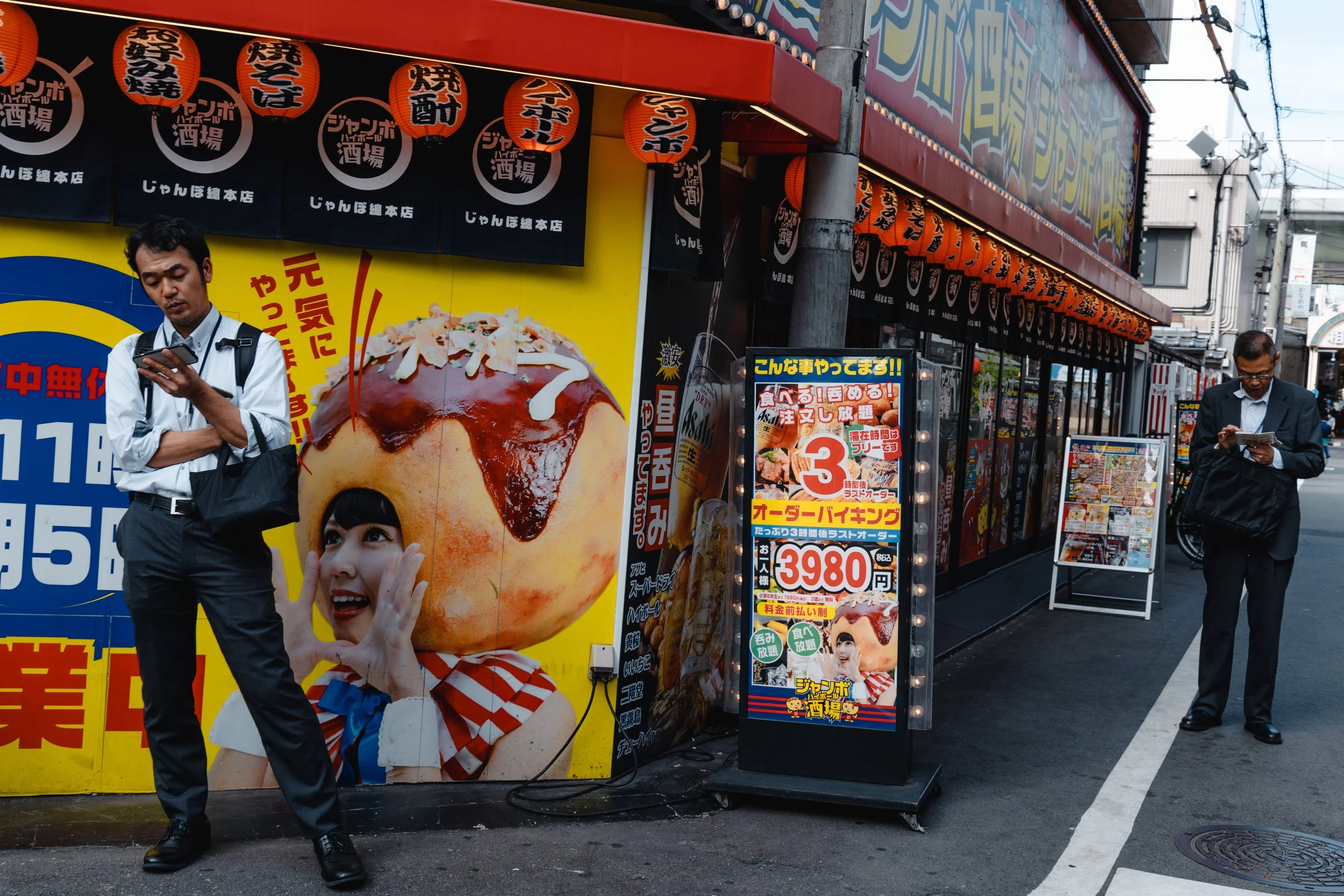
The “everyone on their phone all the time” epidemic.
Among all the cities in Japan — Tokyo, Kyoto, Fukuoka, Sapporo — Osaka offers intimacy and character. The neon-saturated canal streets of Dotonbori, the faded retro charm of Shinsekai, the bohemian laneways of Nakazakicho — every neighbourhood has a visual personality unlike anywhere else in the world.
Try to plan your shoots around light, not just locations. Osaka in the rain transforms completely — wet pavements reflect neon signs in a way that is nothing short of cinematic. Because the buildings are very tall the city doesn’t get a lot of light during the day but don’t worry because the best lights are actually the night lights! That’s when the city looks best in my opinion.
The Best Areas for Street Photography
Umeda (Morning and Noon or Night)
Umeda is often described as the hyper-modern heart of Osaka, and for a street photographer, it’s essentially a high-octane playground of light and geometry. The area is defined by its multi-layered complexity; you have the soaring, futuristic architecture of the Umeda Sky Building and Grand Front Osaka clashing beautifully with the gritty, neon-soaked underground passages and narrow alleyways near the JR tracks. This juxtaposition creates a "cyberpunk" aesthetic that is hard to find elsewhere. Because Umeda is a massive transit hub, the "human element" is constant. You can capture everything from the synchronized chaos of thousands of commuters at the Hanshin crossing to the quiet, solitary moments of a salaryman lost in thought against a backdrop of massive glass facades.
What truly sets Umeda apart, however, is the way it manipulates light. The abundance of glass, steel, and elevated walkways creates intricate shadows and reflections that change dramatically throughout the day. In the late afternoon, the sun hits the skyscrapers, casting long, dramatic silhouettes across the wide plazas, while at night, the area transforms into a kaleidoscope of artificial glow. Between the sleek department stores and the hidden, old-school shotengai (shopping arcades) tucked beneath the tracks, Umeda offers a dense variety of textures. Whether you prefer clean, minimalist architectural shots or high-contrast, candid urban life, Umeda provides a canvas that feels both quintessentially Japanese and bracingly modern.
Dotonbori & Namba (Noon and Night)
During the day, the visual chaos of the canal area — overlapping signs, multiple languages, crowds of people navigating the bridges — creates endless compositional opportunities. At night, the transformation is extraordinary: every surface reflects the neon glow of the signs, and the energy of the crowd intensifies. The Dotonbori canal itself provides a leading line through the frame, and the Ebisubashi Bridge is one of the best vantage points for people-watching in Japan.
Move beyond the main canal into the side streets and alleys. Hozenji Yokocho, the narrow moss-lit alley near the temple, offers atmospheric night photography in a completely different register. The covered arcades north and south of the canal hold their own treasures.
Shinsekai (Day)
Shinsekai is, for many photographers, the most distinctive neighbourhood in Japan. Built in the early 20th century to model both Paris and New York, it has aged into something entirely its own — faded signage, retro restaurant fronts, aged men playing shogi at outdoor tables, pachinko parlour lights bleeding onto the street. The Tsutenkaku Tower provides a vertical anchor, and the surrounding streets have a density of visual detail that rewards slow exploration. Unlike Dotonbori, Shinsekai works beautifully in daylight, giving you clean shots of its extraordinary facades and street life.
The streets immediately around Dobutsumae Station on the south edge of Shinsekai are less touristed and more raw. Explore them for a less polished, more authentic Osaka.
Nakazakicho & Tenma (Day)
For a completely different visual register, the bohemian neighbourhood of Nakazakicho offers charming small-scale scenes — painted wooden facades, art displayed in café windows, vintage clothing on racks outside tiny boutiques. The pace here is slower, the people younger and more arty, and the visual language intimate rather than overwhelming. Combine it with nearby Tenma, where the covered shotengai (shopping arcades) and izakaya alleys have a workaday energy that feels genuinely local.
Osaka Castle Park (Day)
The castle park offers a different kind of photography to the city streets: the contrast between ancient architecture and modern skyline, joggers and tourists moving through a space that has been central to Japanese history for centuries. During cherry blossom and autumn foliage seasons, the park is extraordinary — though extremely crowded. Arrive at opening time for the best light and the thinnest crowds. The moat reflections of the castle on still mornings are some of the most beautiful images you can make in Osaka.
The Subway & Transport Hubs
Japanese people spend enormous amounts of time in transit, and the subway system offers remarkable photographic material. The compression of crowds at peak hours, the blur of motion against still platform elements, the interplay of fluorescent light with commuter faces — all of this rewards patient observation. Umeda and Namba stations, in particular, have a scale and visual complexity that repays time. Shoot from a low angle to emphasise the depth of the underground spaces.
A note: Photography on trains should be approached with considerable discretion.
The Suburbs & Beyond
Venture beyond the main districts and Osaka reveals quieter, more intimate street photography opportunities. The residential neighbourhoods around Tsuruhashi (Osaka's Korean quarter, with covered arcades filled with Korean BBQ restaurants and market stalls), Sakaisuji-Honmachi, and the eastern areas of the city offer a slower, more everyday Osaka that contrasts richly with the commercial intensity of the centre.
Photography Tips Specific to Osaka
Rain is your ally: Japan receives significant rainfall throughout the year, and rainy days transform the streets of Osaka into mirror-like photography playgrounds. Pack a rain cover for your camera and embrace wet weather rather than hiding from it. Although Instagram is full of lights-reflections shots and umbrellas it doesn’t hurt to try, just be creative!
Timing matters: rush hour (8–9am and 6–8pm) in Umeda and Namba provides compressed crowd shots with extraordinary energy. Just after the crowds clear — around 10pm in Dotonbori — you get emptier streets and still-lit neon, ideal for long-exposure work. Keep in mind that lunch-time (noon-2pm) is also a crowded time.
Galleries & Museums for Photography Lovers
The National Museum of Art, Osaka (NMAO)
One of Japan's leading contemporary art museums, the NMAO is remarkable for its architecture alone: the building is entirely underground, accessed through a dramatic bamboo-inspired steel structure designed by Argentine-American architect César Pelli. Inside, a collection of around 8,200 works focuses on contemporary art from Japan and overseas since 1945. Photography, video art, and conceptual work all feature regularly in its rotating programme.
Located on the Nakanoshima riverfront, it shares space with the Science Museum and is easily combined with a visit to the adjacent Nakanoshima Museum.
Nakanoshima Museum of Art, Osaka (NAKKA)
Opened in 2022, NAKKA has quickly established itself as one of the most important art institutions in western Japan. Its collection of over 6,000 works spans from the mid-19th century to the present day, with particular strength in Impressionism, modern art, and contemporary Japanese and international work. The museum mounts ambitious special exhibitions — recent shows have explored Surrealism (featuring significant photographic art by Man Ray and others) and major retrospectives of Western and Japanese modernism. Check the website at nakka-art.jp for the current programme.
teamLab Botanical Garden Osaka
A different kind of gallery experience entirely: the digital art collective teamLab has created an immersive after-dark experience within the Nagai Botanical Garden (Nagai Park) in which light, sound, and natural elements interact in constantly changing ways. It is not a photography gallery in the conventional sense but is one of the most photographed spaces in Japan and offers extraordinary experimental visual experiences for photography-minded visitors.
Photography at TeamLab rewards patience and experimentation with shutter speeds.
Osaka Photography Community & Events
The Tokyo Art Beat website (tokyoartbeat.com/en) covers Osaka as well as Tokyo and is the best English-language resource for tracking current and upcoming exhibitions, photography shows, and art events across the city. New exhibitions open regularly at spaces across the Nakanoshima cultural district and in smaller galleries in Nakazakicho and the surrounding areas.
Oddly, Osaka doesn’t have a very active street photography community. I’m trying to create one (although it is itinerant as I travel quite a lot) through social media, Reddit and platforms like Meetup.
The annual Osaka Photo Awards, focused on documentary and street photography of the Kansai region, is another event to look out for.
Frequently Asked Questions: Osaka Travel & Photography
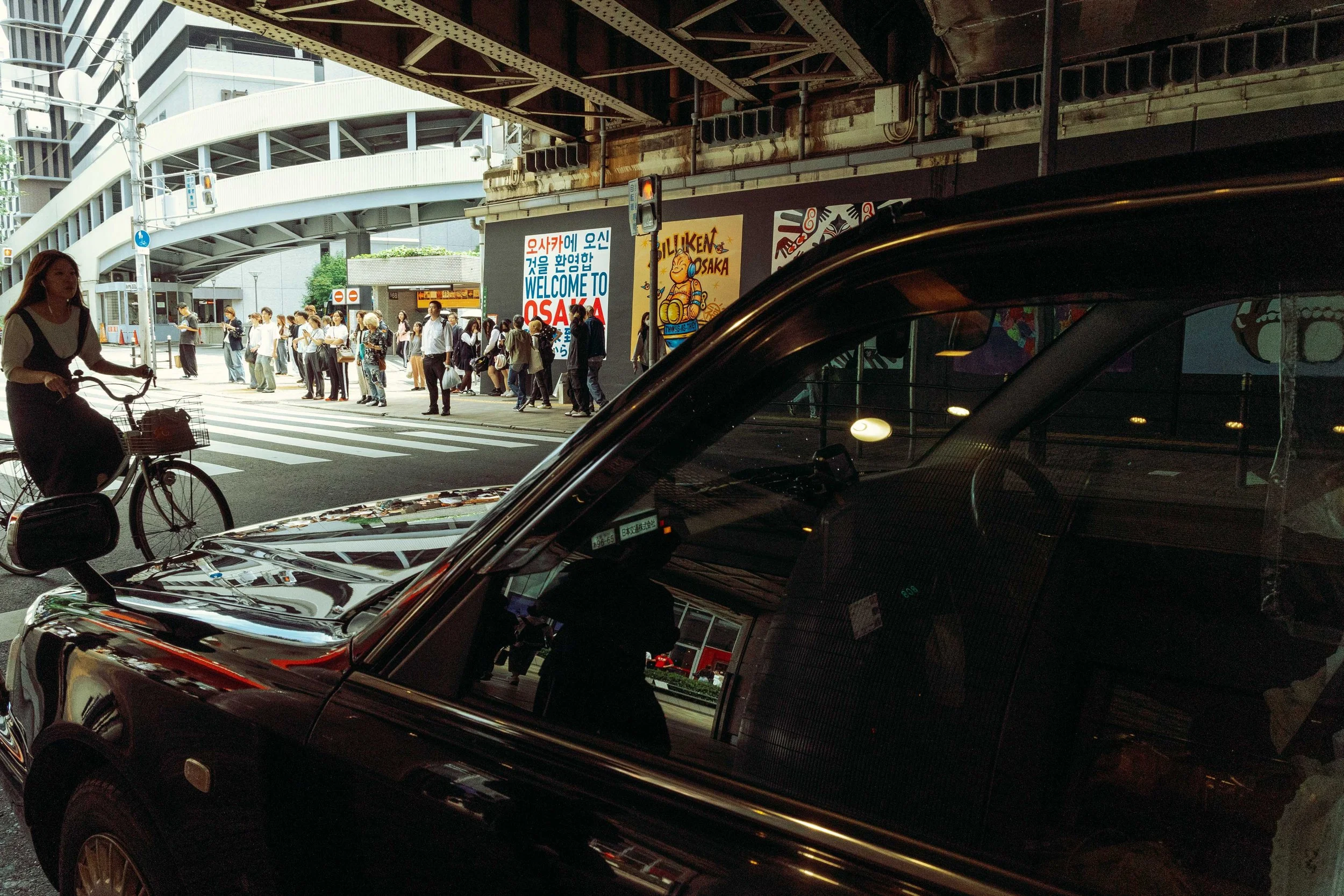
Bikes can ride anywhere, which at times can feel a bit dangerous.
Is Osaka better than Tokyo for street photography?
No. It’s not better, just different. While Tokyo is vast and organized, Osaka is compact and intimate. The "layers" in Osaka—think narrow alleys (yokocho) directly beneath massive glowing billboards—make it easier to capture high-energy, cinematic shots without walking miles between locations.
Where is the best area to stay in Osaka?
For first-timers and photographers, Namba or Shinsaibashi are the top choices. You’ll be within walking distance of Dotonbori, meaning you can shoot late into the night and not worry about catching the last train. If you prefer a more modern, "Metropolis" feel with easy transport links to Kyoto and Tokyo, stay in Umeda.
How do I get the best "neon glow" in my photos?
Osaka is best shot at night. To get that clean neon look:
Shoot in the rain: Wet pavement acts as a mirror for the signs in Dotonbori and Shinsekai.
Underexpose slightly: Digital sensors handle "dark" better than "blown-out" highlights. Lower your exposure to keep the detail in the neon signs.
White Balance: Try setting your white balance to "Tungsten" or "Fluorescent" to enhance the cool blue tones of the city.
Is the JR Pass worth it for an Osaka-based trip?
If you are using Osaka as a base to visit only Kyoto, Nara, and Kobe, the JR Pass is NOT worth it. You are better off using an ICOCA card (contactless) or a Kansai World Pass. The JR Pass only starts making sense if you are taking the Shinkansen to Hiroshima or back to Tokyo.
Is street photography legal in Osaka?
Yes, it is legal to take photos in public spaces. However, Japan has high cultural expectations regarding privacy. If you are taking close-up portraits, a small nod or "Sumimasen" (excuse me) goes a long way. Note: In certain private areas like Tobita Shinchi (red light district), photography is strictly forbidden and enforced by local "monitors"—stay respectful and keep your lens capped there.
How many days do I need in Osaka?
2 to 3 days is enough to see the main city highlights. However, many travelers stay for 5 to 7 days and use Osaka as a cheaper, more central "hub" for day trips to Nara, Kyoto, and Himeji Castle.
Please consider helping support my work by checking out the products below



Welcome to Hong Kong
Hong Kong is a vertical labyrinth of raw cinematic energy, making it an absolute dream for street photography. It’s a city of thrilling visual contrasts—where the intense, neon-lit density of Mong Kok gives way to quiet, hidden alleyways, and grand colonial architecture sits in the shadow of towering glass skyscrapers. From double-decker trams slicing through seas of commuters to abstract reflections, moody shadows, and steam rising from street food stalls, Hong Kong is an endless playground of geometry, scale, and human emotion.
Join internationally recognised street photographers Paolo Maschio and Tom Bugatti (website | Instagram) for an immersive workshop designed to sharpen your eye, refine your technique, and help you carve out your own unique visual voice. Over two full days, we’ll explore two distinct philosophical styles: Paolo’s humanistic approach—focusing on raw emotion, proximity, and individuals navigating the city—and Tom’s formalistic approach, where human subjects become elements of geometry, light, reflection, and abstraction within a larger frame.
Workshop at a Glance
Dates: 16-17 of January 2027
Location: Hong Kong, Hong Kong
Duration: 2 days
Price: 600€ per person
Skill Level: All levels welcome
Group Size: Maximum 10 participants
What to Expect
Two focused days, two distinct visual philosophies, and a city that never stops moving. You’ll be gently pushed to shoot more instinctively, to take the frame you almost talked yourself out of, and to trust your eye whether you're capturing close-range human emotion or abstracting subjects into geometric architecture.
Expect a genuine mix of theory, image critique, and extensive field shooting in one of the most cinematic cities in the world. As participants sign up, we will reach out directly to understand your specific goals and visual interests. Depending on the group's preferences, we will tailor our on-the-street approach—either splitting into smaller targeted groups or alternating leads—to ensure maximum personal attention.
With two instructors sharing the lead, you'll benefit from a rich dual approach. Ultimately, our goal isn't to make you shoot like us, but to help you develop your own distinct way of seeing. There’s no competition here—just a community of photographers learning from two complementary perspectives and from each other.
What You’ll Learn
Whether you've never done street photography before or you're looking to break through a creative plateau, this workshop is designed to give you concrete tools you can keep using long after you leave Hong Kong.
Over the two days we'll cover:
Humanistic vs. Formalistic Approaches — choosing whether to tell a story through personal emotion or through abstract shape, reflection, and structure;
Reading a scene — how to anticipate moments before they happen;
Composition and framing — layers, geometry, and urban scale;
Overcoming hesitation — practical techniques for shooting confidently up close;
Working with available light — navigating moody shadows, neon, and high-contrast reflections;
Editing and curation — how to select your strongest images and understand why they work.
Requirements
No prior experience with street photography is required but you’ll definitely need:
A camera you're comfortable using — DSLR, mirrorless, compact or film, all welcome;
Lenses: Wide lenses for close-quarters shooting are great, but if you are interested in capturing architectural reflections, geometric details, or abstract compositions, please make sure to bring a telephoto lens (100mm or longer);
Comfortable shoes (expect to walk several Km each day);
A laptop for reviewing and post-producing images;
Curiosity, patience, and respect for the people and places we photograph.
Pricing & Booking
The price of the workshop is €600 per person,* and it includes the following:
Pre-workshop outreach to understand your personal goals and tailor the experience;
Portfolio reviews by both Paolo and Tom;
Two days of guided shooting in Hong Kong’s most photographically rich neighbourhoods;
Theory sessions exploring humanistic, formalistic, and abstract street photography;
Daily photo critiques — reviewing your images together and understanding what's working and why;
Personal feedback tailored to your individual level and style.
Transportation, meals, drinks, travel insurance, and any other incurred costs are not included and are to be paid individually.
* All workshop participants receive a 10% discount on any future workshops they attend with me (co-sponsored workshops with other instructors excluded).
Cancellation
There are no refunds in case you need to cancel.
If we need to cancel, you will be refunded in full. We are not responsible for any reimbursement of travel expenses or other costs incurred by participants in the event that we need to cancel. Travel insurance covering cancellations, missed flights, and similar is strongly recommended. There are no partial refunds in the event a participant misses days or takes time off during the workshop for any reason.
FAQ
Do I need to be an experienced photographer?
Not at all. This workshop is open to all skill levels. The only requirement is that you're comfortable handling your own camera. Whether you're just starting out or you've been shooting for years and want fresh eyes on your work, there's something here for you.
What camera should I bring?
Whatever you already own and feel comfortable with. Street photography is about seeing, not gear. A compact camera or even a film camera is absolutely fine but you should know how to operate it.
Will we stay in the same hotel?
Accommodation is not included in the price. If you want I can share recommended areas to make it easy to stay close to the group.
Is travel insurance required?
I strongly recommend taking out travel insurance that covers trip cancellations, medical expenses and lost equipment. This is your responsibility to arrange independently.
I have a question not answered here — can I get in touch?
Absolutely. Reach me through the contacts section of this website and I'll get back to you as soon as I can.